Ceiling Fan Air Movement - CFM or Wind Speed?

Myths and Facts Behind Both
If you’ve been shopping for a ceiling fan and doing some research, you’ve probably learned how important it is to look for the Cubic Feet Per Minute (CFM) rating on each fan to determine how much airflow you will get from each model ceiling fan. You may have also stubbled across some websites that tell you that wind speed is more important than CFM ratings. However, what they don’t tell you about wind speed can be very misleading.

Energy Protection Act Regulates CFM and Not Wind Speed
Did you know that EPA regulations require all ceiling fans manufactured to be sold in the United States must be sent to select testing facilities to be tested for how much airflow each moves overall, and the test are done to show CFM rating, not wind speed?
Wind speed is a calculation based upon overall CFM rating and then taking into account the ceiling fan’s blade span. A mathematical equation is done, in which there are no industry standards for, attempting to give an idea of wind speed in miles per hour. Almost every calculator I’ve found online to estimate wind speed is different, making it very hard to judge the MPH of wind a ceiling fan is moving directly below the blades. I guess that as long as you settle on one calculator and judge every fan from only that one, then in theory you’ll have some sort of fair comparison from one ceiling fan to another.
In our opinion, some retailers have come up with the “wind speed” idea to get a potential buyer to focus away from the regulated government tested results of CFM, and focusing on wind speed instead. Some state that, “wind speed is king”.
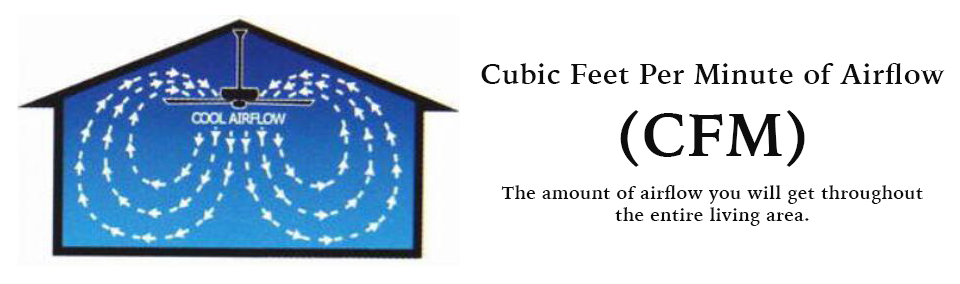
Although wind speed is important if you’re trying to feel a better windchill effect from a ceiling fan, it doesn’t mean you’ll feel that wind speed over the entire room. Usually wind speed is only felt when setting or standing directly underneath a ceiling fan, or no more than a few feet away. Whereas the CFM rating is how much airflow is moved in total volume throughout the entire room, from wall to wall and floor to ceiling. Therefore, CFM ratings factor in the comfort level through the entire room, and not just what you'll feel if standing directly below a ceiling fan, as wind speed calculations do.
Example of Knowing How It Works
Have you ever been outside on hot day with a modest breeze, in an area with several building structures around? Have you noticed that due to those building structures the same breeze may feel stronger in one area than another, all dependent upon how the breeze comes through between the building structures? A downtown area of a city is a prime example of this. Depending upon how much of the wind is blocked, or not blocked by the buildings, will determine how strong the wind feels.
If it’s 90° out and you go between two buildings where they may create a wind tunnel, so to speak, the wind will be stronger in the area between the buildings, and it can create quite a nice cooling breeze on that hot 90° day. However, as soon as you turn the corner and the wind is blocked, that great feeling breeze is gone like it never even happened, leaving you wanting to go back where you came from to get relief from the heat.
Wind speed from a ceiling fan is sort of the same as the breeze between the two buildings that created the wind tunnel effect. To feel the more powerful wind speed you will need to be directly underneath the ceiling fan, or at least very nearby and not far from the tips of the fan blades. This is because most ceiling fans’ initial airflow is directed straight downward and doesn’t begin to spread across the room until it reaches the floor, or a piece of furniture beneath the ceiling fan. From that point the airflow bounces off the floor and spreads towards the walls of the room, where it is then recirculated up the wall and back up to the ceiling, and then back above the fan blades where the pattern continually repeats itself. This is why wind speed is strongest just below the blades, less strong by the time it reaches the floor. It's even less strong the further away from there you get.

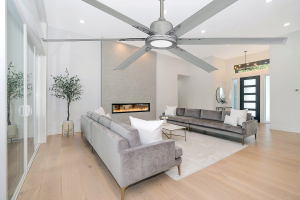
With this in mind, consider you have a large area and you become sold on going away from the regulated cubic feet per minute ratings that all fans are tested for, and instead you rely solely on wind speed opinions. Your room is 20’ x 30’ with a 18’ high ceiling. A ceiling fan with an 84” blade span will perform best. However, because you look and see the wind speed from a 52” ceiling fan is stronger, and because you've been sold on wind speed, it causes you opt for the smaller model, thinking you will feel more airflow in your room since the wind speed is more. You pay to have it installed, only to find out two things after paying the electrician for the installation. One, the fan looks ridiculously small in your large open room. And two, you find out it feels pretty good directly below the blades, but away from the fan, where you actually sit, it is not doing much for you. Should have went with the larger fan with the higher CFM rating! You know, the 84" model that blows 14,300 CFM venues the 52" one that blows a maximum of 7,000 CFM. You saw that before the purchase, but the wind speed calculation led you to believe the 52" ceiling fan was going to feel better.
The reason the larger fan with the higher CFM rating will work best is, even through the wind speed may be slightly lower is because the overall airflow is more, and spread over a much longer blade span, thus allowing the ceiling fan to fill a much bigger area with airflow. The air is spread across the living space much quicker where it gets to and up the walls, back to the ceiling and behind the fan blades to be recirculated again into the room. It may be less wind speed, but much more airflow moved in the room overall.
My Personal Ceiling Fan Airflow Experience
From personal experience, I have an 18’ x 19’ family room with a 16’ peaked ceiling. When my wife and I first built our home a 56” fan was the biggest ceiling fan available, and so we installed a 56” ceiling fan in the space. At the time, it was a very powerful, 6-speed Casablanca fan called the Bel Air Halo. The fan moved a lot of airflow compared to others manufactured at the time, and if I was seated in an area below the fan I felt comfortable with it only on its second speed setting. The problem was that on that speed the air wasn't felt while sitting on the couch near the wall further from the fan. To feel the air there the fan needed to be turned up to at least speed four. The 4th speed then became annoying when setting on the sofa that was more so below the fan blades, because it was too much “wind speed” directly underneath the fan.
Once larger fans became available I decided to replace my old Casablanca with a 72” ceiling fan. Since our family room is open to the kitchen, the true size of the area is 18’ x 33’. After seeing the 72” fan didn’t look overly large in the space, I decided to give it a go and try the TroposAir 84” Titan II ceiling fan. Switching to the 84” ceiling fan is the best decision ever made when it comes to a ceiling fan for that area. Of the six speeds, speed one is enough to gently circulate airflow throughout the entire room with no annoying spots where air movement isn’t felt. No overly powerful and annoying wind directly below it, or dead spots away from it. Just perfect, nice, smooth and even airflow through the entire living area. Like most people, we have central air, so I have never needed to use the fan above speed two of its six.
Outdoor the Need for Wind Speed My Be Necessary
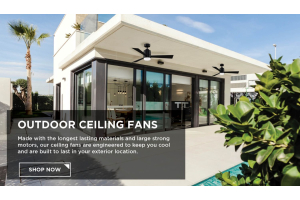
When shopping for an outdoor ceiling fan, since there is no central A/C outside, I do agree that a fan with higher wind speed is best. This is also because without four walls to keep the airflow recirculating, as you'll have indoors, the more wind speed that can be produced above all sitting areas the better.
With that in mind, and if your outdoor living area is larger, how do you get that higher wind speed felt further away from the fan? You will still run into the same issue as with the indoor fans, where a smaller fan may calculate at a higher wind speed, even though the cubic feet per minute of airflow may be far less than a larger fan. Therefore, the wind speed is only good if sitting in a very close proximity to the fan itself. So again, can you get more wind speed throughout the outdoor living space, and just in the center where the fan may be?
The answer is simple: You will need more fans, spaced with the blades just a few feet apart, across the outdoor living area, or you’ll need to spend more money on a more powerful larger fan that has the ability to do the job of both high CFMs and high wind speeds. There are not many fans with extra long blades spans that can create both great CFM ratings and high wind speed together though. This is because the fans with longer blades tend to spin and lower RPMs. The sheer size of the blades creates a really good CFM rating, but because they are spinning at slower speeds the wind speed suffers. They are designed to spin slower for a more comfortable and consistent breeze throughout a big living space, and that's exactly why they are referred to as HVLS fans, or High Volume Low Speed Fans.
My strongest suggestion for a fan if you have a 20' x 20' plus sized outdoor living area, and you gravitate toward the popular really big ceiling fan designs, is one of the few that creates both great wind speeds and high CFM ratings, the TroposAir Liberator. It comes in your choice of a 72 inch, an 84 inch, or a 96 inch blade span. For 20' x 20' the 82" version is large enough. If your space is 25' x 25' you may want to opt for the 96 inch blades. If your space if rectangular, something like 20' x 30' you'll be better off going with two and using the 72" fan blades.
Some websites may suggest that installing three or four 52" ceiling fans in an outdoor space like that is a great option. For wind speed, yes, but they still won't do the job of two 72" Liberators. Plus, the Liberators are going to look so much better than a bunch a little fans all over the place.
When Installing Outdoors, Remember Fans Are Not A/C
Just as a reminder, no matter how good and powerful the ceiling fan/fans you install in an outdoor living area may be, no ceiling fan is going to be able to make a humid 98° day feel like an air conditioned 72° indoor living space. Yes, a good fan will make a difference, and it will most definitely make the late evenings, of those same 98 degree days, out on the covered deck feel like paradise. However remember this, that although a good fan may make the 98 degree heat of the day feel like 91, 91 degrees is still hot. Therefore, please don't read this article and think you're going to see a miracle happen 24/7 throughout the entire summer by installing a ceiling fan outside. But just wait until the sun goes down and then go outside and enjoy life. And the spring and fall... Oh yeah! All day comfort!
Conclusion
Although, both CFM and wind speed can be beneficial, remember CFM is the only number regulated as a standard throughout the industry. Usually a higher CFM rating on any sized fan is the best way to go. Therefore, base your ceiling fan size on the size room the fan will be installed in, and then look for the highest CFM rating you can find, in a style ceiling fan you like. With that in mind, you should certainly be happy with the model you choose.
If you have any questions before purchasing a fan, we sincerely invite you to call one of our knowledgeable staff for assistance. If you’re shopping for a new ceiling fan, we are always here to help you make the right choice the first time. We are here to help take the guesswork out of your shopping experience.
Name Brand Ceiling Fans at Modern Fan Outlet
Ceiling Fans by Design Categories
| MODERN OUTDOOR TRADITIONAL SMALL |
LARGE NAUTICAL ORNATE KIDS |
TROPICAL DOUBLE MOTOR ORNATE CLEARANCE |
FANS WITH LIGHTS RUSTIC MISSION |